Blown Film Die Diagram: What's Inside a Co-Extrusion Die
2026-11-04Two quotes for the "same" three-layer line can sit a third of the price apart, and the difference usually lives in the part nobody photographs: the die. What follows is a labelled cross-section of a co-extrusion die — what each piece does, how the layers form, and which numbers to ask a supplier for. It is a schematic: the proportions show how the melt flows, not the dimensions of any one machine.
What the Die Actually Does
The die sits between the extruders and the bubble and does three jobs at once: it spreads each extruder's melt into an even ring, brings those rings together so every layer ends up where you want it, and forms the annular opening the bubble is drawn from.
Everything upstream and downstream is judged by what leaves that opening. A gauge band, a faint longitudinal line, a seal that fails: by the time you see it on the roll, the cause is usually already set inside the die.
The Blown Film Die Diagram, Labeled
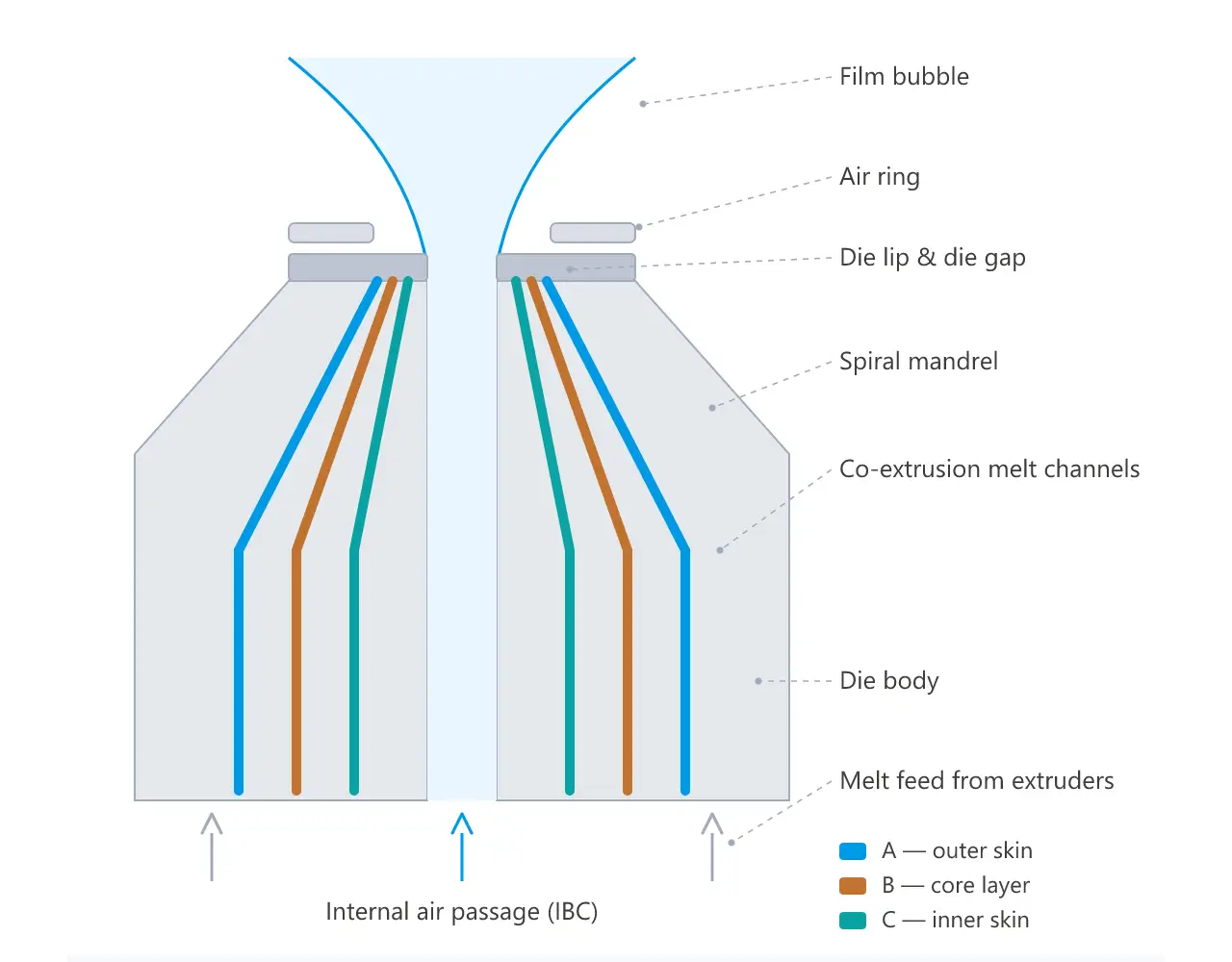
Figure: labelled cross-section of a co-extrusion blown film die. Schematic — proportions show the melt path, not the dimensions of any one machine.
Working up from the base of the section:
-
Melt feed from extruders. One inlet per extruder. Two inlets mean an ABA die, where the A stream is split and fed to both surfaces; three mean an ABC die.
-
Spiral mandrel. The distributor — it turns a single point of melt into a full ring of even thickness.
-
Co-extrusion melt channels. The path each layer follows before the layers meet; where they merge sets the layer order.
-
Die lip and die gap. The lip is the machined edge the melt leaves from; the gap is the fixed radial opening between the inner and outer lip.
-
Film bubble. What leaves the lip: a molten tube that is cooled, inflated and pulled up into film.
Two parts sit around that section. The air ring blows on the base of the bubble to hold it steady. Down the centre runs the internal air passage — on a line with internal bubble cooling (IBC), that is where the cooling air enters the bubble, and one reason the same tower can run more kilos.
Inside the Spiral Mandrel
The hardest job in the die is turning one stream of melt into a ring of perfectly even thickness. The spiral mandrel does it with helical grooves that overlap as they climb, splitting, re-combining and re-splitting the melt before it reaches the lip.
Where that goes wrong, you see it on the roll. Grooves that overlap poorly, or too few of them for the die diameter, leave a faint longitudinal line — a spiral mark, or die line — at the same position on every roll. The same design detail sits behind much of the gauge variation that shows up as bands across the width. It is built into the mandrel with no field fix, which is why two dies with identical outside dimensions can make very different film.
How the Layers Get Combined
The number of layers a die can make is the number of melt channels it carries to the lip.
A single-layer die has one feed. An ABA die has two and splits the A stream to both surfaces, so the film comes out symmetric and the core is free to take recycled or off-spec resin without changing either face. An ABC die runs three-layer co-extrusion with three separate channels, so each skin can carry its own resin and the film can be deliberately asymmetric.
| Die | Extruders | Layer order | What it buys you |
|---|---|---|---|
| Single layer | 1 | — | Simplicity, lowest cost |
| ABA | 2 | A–B–A, identical faces | Cheap core, no change to either surface |
| ABC | 3 | A–B–C, faces can differ | Each skin its own resin; print on one face, seal on the other |
| 5-layer | 3+ | More layers, plus tie layers | A barrier bonded from both sides |
Our standard platforms cover ABA dies with two extruders and three-layer ABC co-extrusion dies, moving to the 1–5 layer platform when a barrier needs bonding from both sides. For the short version of ABA vs ABC, see our explainer.
What Sets the Layer Ratio
Nothing inside the die is set to a ratio. The die fixes how many layers there are and in what order; the thickness of each one is set back at the extruders, so pushing more melt from one or running the haul-off faster changes that layer's share.
That is what the A/B/A % on a quote refers to — and why the extruder sizes matter as much as the die: a ratio you cannot hold on the line is not a ratio you can sell.
Die Diameter, Die Gap and Film Width
Two numbers on the die sheet decide what film you can make.
Die diameter sets the circle the film starts from. Layflat width comes out close to 1.57 × die diameter × blow-up ratio — the 1.57 is π/2, half the bubble's circumference. Put numbers to it: film 100cm wide needs a bubble diameter of about 63.7cm; at a blow-up ratio of 4 that calls for a 16cm die, at 6.5 only 10cm, which is why a die around 12cm is the sensible pick for that width.
Die gap is the radial opening at the lip — a fixed mechanical dimension, sitting around the 1 mm mark on most lines, close enough that "about 1 mm" is the right order of magnitude for a spec sheet or a selection discussion. It balances pressure against draw. Below roughly 0.6 mm the head pressure climbs and the melt can fracture, leaving extrusion lines or a rough finish; above roughly 2.5 mm the pressure drops, but the draw ratio rises with it, pulling machine- and transverse-direction properties apart and making gauge control hard to hold. In production it becomes a resin question: running LLDPE or a metallocene grade, you will usually ease it toward 1.5 mm.
Neither number is adjustable on the day. Wider means a different die; narrower trades away transverse strength — covered in blow-up ratio of a film blowing machine.
Choosing a Die Construction — and the Questions to Ask
Read the die and you can predict most of what the film does: layer uniformity and gauge flatness come from the spiral mandrel, where the barrier sits comes from the channel arrangement, seal strength from a dedicated inner layer, and curl from symmetry — an A–B–A build cools flat, while an asymmetric one has to be balanced on purpose. For what these lines make and who buys them, start with what a film blowing machine is used for.
Symmetric film with cost as the driver: a single-layer or ABA die. Two faces with different jobs: ABC. A barrier needing tie layers on both sides: 5-layer — the cost comparison is in single-layer vs multi-layer machines.
Then ask a supplier three things:
-
What is the die gap, and why that number for my resin? A real answer names your material.
-
How many spirals does the mandrel carry — and at what lead angle and depth? Spiral count is not a standalone spec: on most dies it sits between 4 and 12, and it has to match the lead angle, the groove depth and the cooling you run. Too few for the diameter is how spiral marks start.
-
If my width changes by 300mm, what changes — the die, the tower, or nothing? It tells you whether you are buying a platform or a one-off.
If your film needs a structure no catalogue die covers, that is a job for a custom film blowing machine.
By Ryan Zhang, CEO, Jiangyin Yuexing Machinery Co., Ltd. — manufacturing film blowing machines since 1996, with over 2,000 installations across 30+ countries.
📧 ryanzhang911222@gmail.com | 📱 WhatsApp +86 13771616165 | 🌐 https://yxfilmblowingmachine.com/
Expert Insights & FAQ
Previous:Multi-Layer Film Blowing Machine: ABA, ABC or 5-Layer?
Next:Nothing...