Thin Gauge Film Bag Machine: Holding Gauge at the Thin End
2026-11-11Bag film is where a blown film line gets judged most harshly. A thick film forgives a lot; the thin end does not. This is the part of the range where a line that looks fine on paper starts showing gauge bands, wrinkles at the winder, and a bubble that will not sit still.
So when a buyer asks for a thin gauge film bag machine, the real question is not how thin it can go. It is how steady it can hold. Those are different machines.
What "Thin Gauge" Actually Means
Thin gauge is a relative term, not a number. For vest bags, liners and light garbage bags it means the bottom of the range a given line can hold — and where that bottom sits depends on the resin, the bag spec and the width you are running.
That is why two suppliers can both quote a "thin gauge bag line" and mean different machines. What changes as you go thinner is not only the die gap. The melt has less time in the die, the bubble has less stiffness to hold its shape, and the haul-off has to pull harder to hit the same output. Each of those is a place where thickness starts to drift. The downstream half of the line feels it too: a bag machine sealing thin film runs a narrower temperature window, and a converter running thin liners at speed notices every metre of variation that a thick-film buyer would never see.
Where Thin Gauge Breaks First
Holding gauge at the thin end fails in three predictable ways.
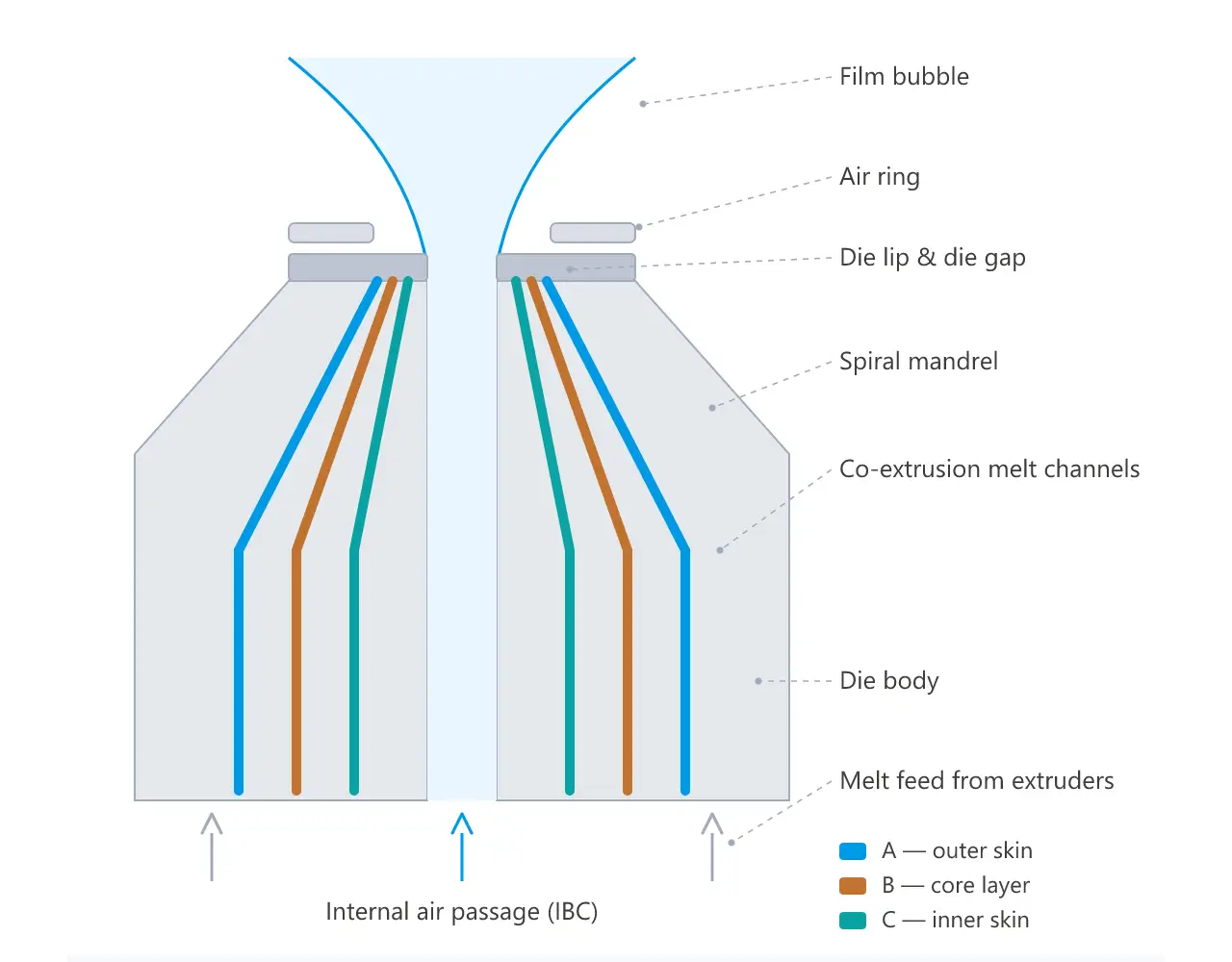
Gauge bands across the roll. Thickness varies from one edge to the other. It usually starts in the die: a spiral mandrel that is not distributing evenly, or a die gap that is worn or set unevenly. On thick film you can live with it. On thin film it is the difference between a bag that seals and one that leaks. If you want to see where that variation is born, the cross-section of a blown film die is worth ten minutes.
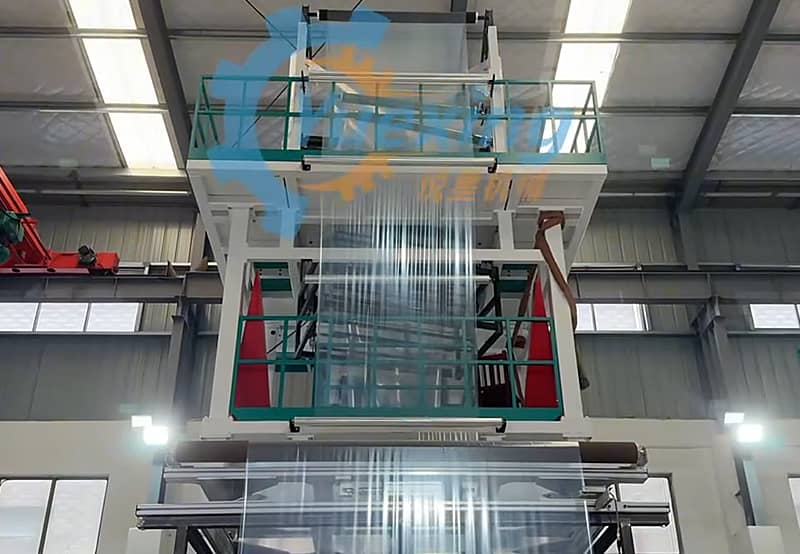
Bubble instability. A thin bubble has less mass and less stiffness, so it reacts faster to everything: air ring pressure, melt temperature, haul-off speed, even a draught across the tower. A line that runs quietly at a heavier gauge will hunt at the thin end, and hunting shows up as thickness variation a few seconds later.Which is why covering both 15–20 micron bag film and 150 micron heavy-duty film on one line is a narrower window than it sounds - here is what the machine has to be able to do.
Wrinkles and slip at the winder. Thin film is more sensitive to tension. A winder that is perfectly adequate for thick film will leave slack edges or tight lanes on thin, and both end up as waste in the bag machine. In practice this is the first place a thin-gauge line shows its age: the winder was sized years ago for a thicker job.
What a Thin-Gauge Line Actually Needs
The machine is not exotic. It is simply built with less margin for error. Almost every specification that matters on a thin-gauge bag line is about removing a source of variation, not adding a feature.
Screw and output stability. You want output that does not surge, more than output that is large. A surging screw cannot be corrected downstream, and at thin gauge the surge arrives as a thickness wave.
Die and air ring. Even distribution out of the die, and an air ring that actually controls the bubble rather than just blowing at it. Small die quality differences that are invisible on thick film show up immediately here.
Gauge control. Manual is workable. Automatic is how you hold a thin spec across a long run without an operator babysitting the tower.
Winder. Tension control matters more on this film than on any other. This is the component buyers most often specify down, and the one they regret.
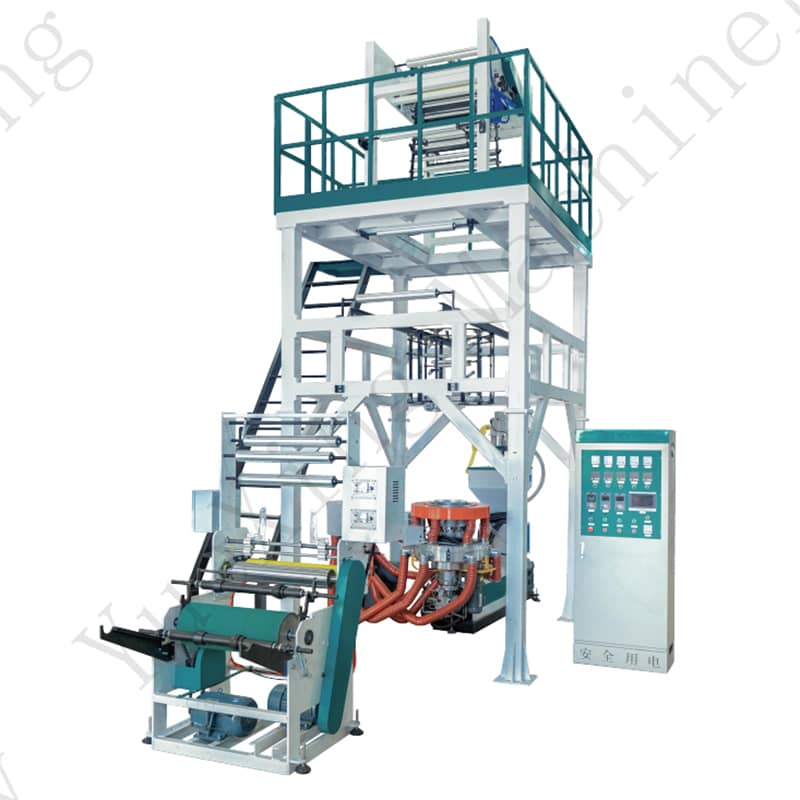
Our single-layer platforms for bag film are the LDPE range and the HDPE range.
Single Layer or ABA
| Build | Best for | Trade-off |
|---|---|---|
| Single layer | One resin, one colour, long runs of bag film | Nowhere to hide a cheaper material |
| ABA | Recycled or off-spec core, clean faces | More machine, more setup, more to hold steady |
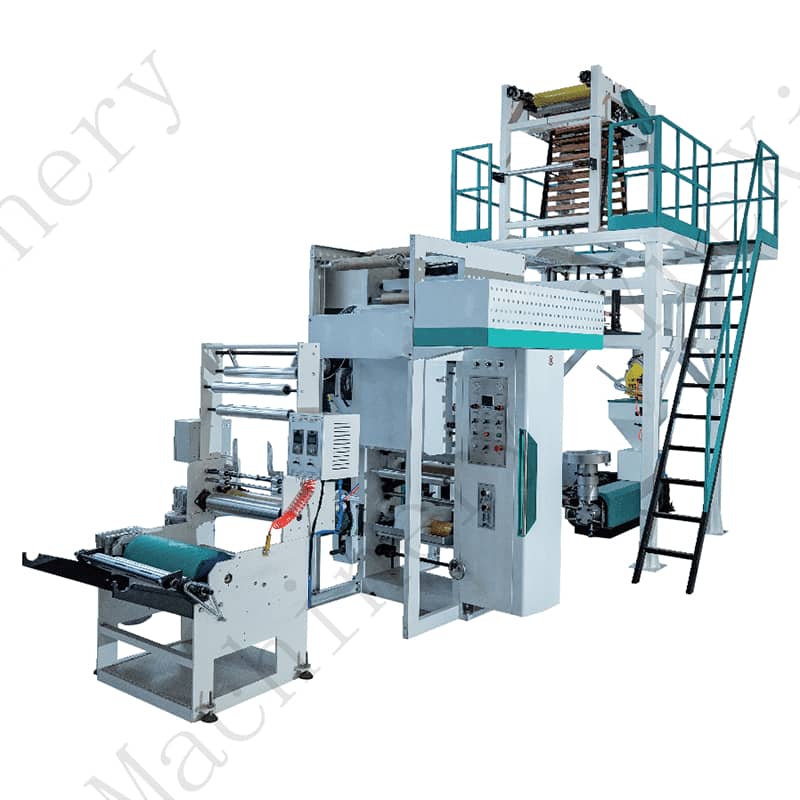
Most thin bag film runs on single layer: one resin, one thickness target, a line that repeats the same job. ABA earns its place when the bag can carry a recycled core and still needs a clean face on both sides — which happens more often than people assume for garbage and carrier bags. The five applications where an ABA line pays off is the short version, the cost comparison covers the arithmetic, and the machine itself is our ABA platform, where two extruders feed both faces and the core.
Output and Thickness Move Together
Throughput and gauge are the same equation. On a fixed die and width, going thinner at the same haul-off speed means less output per hour. To keep the output, you speed up — and everything that was marginal gets worse.
That is why "how many kilos an hour" and "how thin" have to be quoted together. A line rated at a headline output figure will not reach it at the thin end of its range, and a supplier who quotes the two separately is quoting a machine you may not be able to run.
The same logic makes blow-up ratio matter more here than on thick film. It sets the balance between machine-direction and transverse properties, and a thin bubble shows an unbalanced structure faster: the film starts to want to split along one direction, and the bag machine feels it before the lab does. Width pulls the same way: a wider die buys output per hour but spreads the same gauge tolerance across more film, so the control you have at 700mm does not automatically hold at 1,100mm. That is why thin-gauge quotes are usually tied to a width band rather than a single figure.
Specifying a Thin-Gauge Machine: Three Questions
What thickness, at what width, at what output — together? A supplier who answers only one of the three has not answered.
How is gauge controlled, and how often is it measured? Manual versus automatic is a real cost difference and a real quality difference, and it decides how much of the spec depends on the operator.
What is the winder rated for at this thickness? Slack edges and tight lanes on thin film usually trace back to a winder chosen for a thicker job.
If the bag needs something outside the standard range — a barrier, a special resin, or a width no catalogue model covers — the starting point is what a film blowing machine is used for, then a custom build.
By Ryan Zhang, CEO, Jiangyin Yuexing Machinery Co., Ltd. — manufacturing film blowing machines since 1996, with over 2,000 installations across 30+ countries.
📧 ryanzhang911222@gmail.com | 📱 WhatsApp +86 13771616165 | 🌐 https://yxfilmblowingmachine.com/
Expert Insights & FAQ
Previous:Blown Film Die Diagram: What's Inside a Co-Extrusion Die
Next:Nothing...